What Are You Afraid Of?
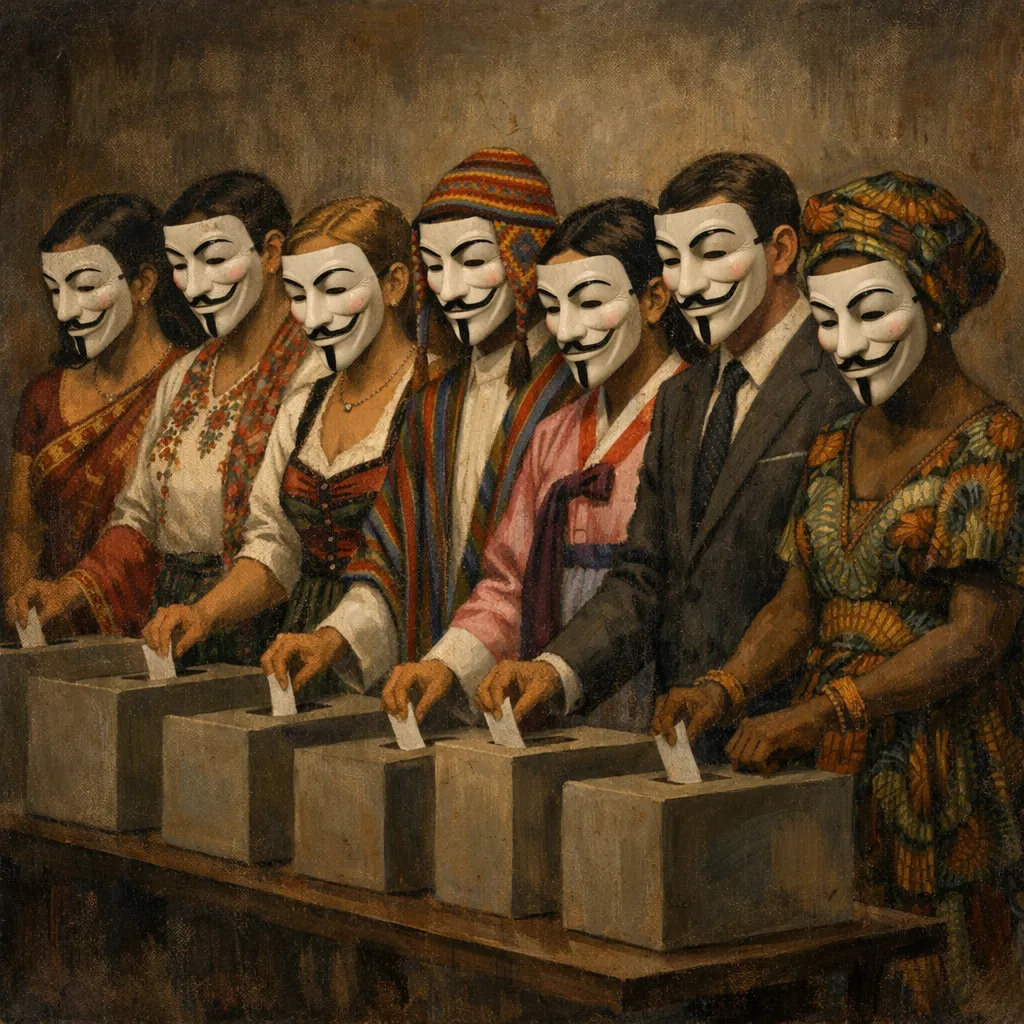
The SAVE Act, from a Republican immigrant who’s lived the paperwork.
There is a dress hanging in my closet that I wore to my naturalization ceremony. I did not take the photograph that day. That president did not represent my values. I am still waiting to take it with the one who does.
In a drawer there is a Venezuelan cédula de identidad, expired, because the regime that does not want my vote is the same regime that will not renew my documents. Millions of Venezuelans abroad hold the same expired paper. That is not incompetence. That is strategy. A government that controls who can prove their identity controls who can participate in democracy. I know this because I lived it.
I also hold an American passport. I got it when I became a citizen. My name had already changed at marriage, so my green card and my naturalization papers carried my married name. No confusion. No mismatch. No drama. The system handled it because the information is in the computer, tied to a Social Security number, and every government agency in this country knows exactly who I am when it wants to find me. It was not complicated. This is the easiest country on earth to document yourself.
I carry both of these things. The expired document from a country that weaponized identification to silence its citizens, and the American passport from a country that barely verifies identification before letting people vote. One is tyranny. The other is chaos. Neither is democracy.
The SAVE Act, the Safeguard American Voter Eligibility Act, asks the United States to do something that one hundred and seventy-six countries already do: require proof of citizenship before a person can register to vote. That this is controversial tells you more about the people opposing it than about the legislation itself.
I was born in Venezuela. I lived in Colombia as an extranjera, a foreigner, carrying a document that said so. My father was born in Italy. My stepmother is American. My family has renounced, adopted, and earned citizenship across continents. My husband is Cypriot. We both came from countries where we understood that citizenship, borders, and sovereignty are not abstract concepts. They are things that can be taken.
I came to the United States on a student visa. I became a citizen. Between those two points, I went through every step the system asked of me, because that is how the process works and because I believe in it. Even with an American stepmother since I was six years old, the system said no while we lived in Venezuela. I think that is fair. I think a country has the right to say: you do not live here, you do not get the benefits of being here.
My husband and I became citizens for one reason. So we could vote. Not for travel convenience. Not for a better passport. For the vote. Because we came from places where we understood what that right was worth, because we came from places where it had been stolen. I would turn in every other passport I hold if I had to choose. Because I live here. I love this country. And I am a proud American.
I registered to vote the day I was naturalized. At the ceremony. You prove you are a citizen, and you register. One moment. One verification. One right, earned.
When I grew up in Venezuela, you voted with your cédula de identidad. They scanned your fingerprint. After you cast your ballot, they inked your pinky finger so you could not vote twice. That was normal. That was how a functioning democracy verified its participants. The elections were not always honest. Chávez probably won legitimately at least twice before the machinery of manipulation took over. But the infrastructure for verification existed in a country with a fraction of America’s resources.
In Colombia, the cédula de ciudadanía and the cédula de extranjería are two entirely different documents. Different numbers. Different rights. You do not vote with the wrong one. Nobody argues about whether this is discriminatory. It is simply how a country distinguishes between its citizens and its guests.
Mexico, after years of rampant electoral fraud, reformed its entire system in 1991. The government issued free biometric voter identification to every citizen. It banned absentee ballots. It required in-person registration. Turnout did not decrease. It increased, from an average of fifty-nine percent in the three elections before the reform to sixty-eight percent in the three elections after. The system became stricter and more people participated, because people participate when they trust the process.
Canada requires citizenship to vote and identification at the polls. You want to become Canadian? Three years of permanent residency, a language proficiency test, a knowledge exam, and a clean record. Then you vote. Not before.
One hundred and seventy-six countries and jurisdictions require some form of voter identification. Thirty-three of thirty-eight OECD nations require government-issued identification at the polls. Virtually every nation in Europe, the Americas, Asia, Africa, and Oceania requires it. India, with one point four billion people, hundreds of languages, and vast rural poverty, built the largest biometric identification system in human history and issues dedicated voter identification cards to its citizens. Virtually every country in Africa requires voter identification.
The United States, at the federal level, requires none of this. The country that calls itself the leader of the free world is the outlier, not the standard. And there is not a single country on earth where an American can show up, legally or illegally, and vote without being a citizen. Not one. Not in Europe. Not in the Americas. Not in Asia. Not in the Middle East. Not in Oceania. Not in Africa. You overstay your visa in Colombia, you are deported. You overstay in Japan, you are deported and banned. You overstay in Mexico, you are detained and removed. You overstay in Canada, you are removed. Nobody calls those countries racist for enforcing their own laws. And none of them would let us vote in their elections.
Only thirty-three countries on earth grant unrestricted birthright citizenship, automatic citizenship to anyone born within their borders regardless of their parents’ status. Nearly all of them are in the Americas. The reason is not ideological generosity. It is historical mechanics. The entire continent was built by immigration, from Canada to Argentina. Everyone came from somewhere else. These are settler nations. The only people who would have standing to object are the ones who were here first. That conversation belongs to them, and it is a different essay.
The rest of the world runs on jus sanguinis, the right of blood. Citizenship by descent. Italy will grant you citizenship because your grandfather was Italian, even if your family left generations ago and no one has set foot there since. Israel’s Law of Return grants any Jewish person the right to immigrate and claim citizenship, and Jewish identity under religious law passes through the mother. Germany will not grant citizenship to a child born on German soil if the parents are foreign. I have a friend from middle school who was born in Germany. German hospital. German birth certificate. She is Venezuelan, not German. Nobody writes editorials about how Germany is denying her human rights. Every civilization defines belonging through its own logic: paternal blood, maternal blood, faith, soil, tribal lineage. None of them are considered exclusionary for it.
And every single one of these countries, jus soli and jus sanguinis alike, the most generous and the most restrictive, requires you to prove who you are before you vote.
For over two hundred years, registering to vote in the United States was a deliberate act. You went to a specific place. You did one thing. You declared yourself a participant in democracy. In 1965, the Voting Rights Act removed the discriminatory barriers: literacy tests, poll taxes, the tools that had been weaponized against Black voters. That was necessary. That was justice. But it did not change the mechanics of registration. It simply said: you cannot use the process as a weapon against eligible citizens.
In 1992, Congress passed a bill that would fuse voter registration to the Department of Motor Vehicles. President George H.W. Bush vetoed it. In 1993, President Bill Clinton signed a nearly identical version into law. The National Voter Registration Act, nicknamed the Motor Voter Act, did not just connect voting to driving. It connected voting to welfare offices, disability services, military recruitment offices, and the mailbox. All at once. All without citizenship verification behind any of them. A driver’s license application became a voter registration application. A visit to a public assistance office for food stamps, Medicaid, or disability services became a voter registration opportunity, even for noncitizens who are eligible for those benefits but not eligible to vote. A mail-in form with a checkbox that says “I attest I am a citizen,” with no mechanism to verify the claim, became a valid path onto the voter rolls.
In 1965, Congress removed the barriers that prevented eligible citizens from voting. In 1993, a Democratic president removed the barriers that separated voting from driving, from welfare, from the mailbox. The first was justice. The second created the flaw the SAVE Act is trying to repair.
In 2001, when I received my first American driver’s license on a student visa, I could have checked that box and registered to vote. No one would have stopped me. No one would have verified. I did not do it, because I understood what citizenship meant. Because I came from a country where the vote was sacred enough to steal. But not everyone who walks up to that counter carries that framework. When someone at a DMV asks a person who does not speak English well, who comes from a country where the government tells you what to do, whether they would like to register to vote, that does not sound like a question. It sounds like an instruction. And the system has no mechanism to catch the ones who check the box when they should not.
Nineteen states and the District of Columbia now issue driver’s licenses to undocumented immigrants without requiring proof of legal status. Every one of those states except one is controlled by the same party that signed the Motor Voter Act. The same party that fused driving to voting created the conditions under which people without legal status can obtain the document that triggers voter registration. In California alone, over nine hundred thousand people without proof of legal presence obtained driver’s licenses by 2017. Every one of them walked through a DMV that is federally mandated to offer voter registration.
California was Mexico until 1848. Today Mexico requires legal documentation for a driver’s license, a free biometric voter ID for every citizen, and deports people who overstay their visas. California does none of these things. Maybe it does want to be Mexico again. Mexico would run it better.
The two countries that share America’s borders neither issue driver’s licenses without proof of legal status nor let noncitizens vote. Are we going to claim they do not share the same foundations as the United States? They do. The same continent. The same settler history. The same Christian heritage. And both of them run a tighter system than we do.
Nobody needs to claim that millions of noncitizens are voting. The point is simpler and more damning: the system was designed with no reliable way to know. And the people who designed it are the same people fighting to keep it that way. In 1993, a Democratic president signed the law that created the vulnerability. In 2026, the Democratic minority in the Senate is filibustering the law that would close it. The legislative record speaks for itself.
Mail-in voting is restricted or unavailable in most of the world. France banned domestic postal voting in 1975. Mexico banned it in 1991. Belgium banned it in 2018. No other country in the Americas allows postal ballots in national elections. The United States mails them unsolicited in some states and accepts them weeks after election day. Virtually no comparable democracy on earth does this.
I have personally been in the car that transported ballots from a voting center to a fire department collection point. A civilian car. No law enforcement escort. No military chain of custody. No sealed containers with tamper-proof documentation. Ballots that determine who controls the armed forces, the nuclear codes, the economy, and foreign policy, transported like groceries.
The arguments against the SAVE Act do not survive contact with the world’s evidence.
They say requiring proof of citizenship is racist. India requires it. Mexico requires it. Canada requires it. Virtually every nation in Africa requires it. Virtually every nation in Oceania with elections requires it. Eighty-two percent of Hispanic Americans and seventy-six percent of Black Americans support voter identification requirements. The people this policy is supposedly oppressing are overwhelmingly in favor of it.
They say married women who changed their names cannot navigate the documentation. If a woman can obtain a marriage license, update her driver’s license, open a bank account, board an airplane, apply for government assistance, file taxes, and collect Social Security, all of which require identity verification, she can prove her citizenship to vote. The government has no confusion about her identity when it wants to collect taxes. Her name, her Social Security number, every address change, every marriage: the IRS tracks it all. The system works perfectly when it is taking money. It only loses track of people when it is time to verify who decides how that money gets spent.
They say it is too hard for some Americans to get identification. Then the first world country story is a lie. You cannot claim American exceptionalism and American incompetence in the same argument. Either this is a nation capable of doing what India has already done, or it is not. And if it is not, that failure is the emergency, not the SAVE Act. The answer to “some citizens cannot get documents” is not to remove the requirement for documents. It is to get those citizens documented. The United States Postal Service operates over thirty-one thousand locations across the country. They already collect documentation for passports: birth certificates, naturalization papers, photos, fees. The infrastructure for verifying citizenship and issuing a document based on that verification already exists in virtually every community in America. We live in a world where I am talking to a machine that holds the context of my entire life across months of conversation. Do not tell me the most technologically advanced nation on earth cannot figure out how to verify whether its own citizens are citizens. And if we think it is a lot of work, let us roll up our sleeves and do it.
And as a woman, as a minority, as a legal immigrant who has managed her documentation across multiple countries and languages, I am deeply offended by anyone who suggests I am not capable of managing my own paperwork. That suggestion is not advocacy. It is condescension. It is the most patronizing position in this entire debate, and it comes exclusively from the side that claims to champion my dignity. The people claiming to protect me are the ones telling me I cannot do what every adult in one hundred and seventy-six countries does without complaint.
The solution is not complicated. There are only two entry points into the right to vote. Birth or naturalization.
If you were born in the United States, your birth certificate is your proof of citizenship. If you were naturalized, your naturalization certificate is your proof. These are the only two documents that establish citizenship. Not a driver’s license. Not a REAL ID. REAL ID proves legal presence, not citizenship. Green card holders, visa holders, and DACA recipients are all eligible for REAL ID. The star on the card looks the same whether you are a citizen or a guest. No form of driver’s license, standard or federally compliant, can distinguish between a citizen and a noncitizen. Only a birth certificate or a naturalization certificate can do that.
Registration works the same way a passport application works. You bring your birth certificate to prove citizenship. You bring a photo ID to prove you are the person on the birth certificate. If your name has changed since birth, you bring your marriage license. Three documents maximum. Every woman who has ever applied for a passport after changing her name has done exactly this. The process already exists. It is already routine. The only place it is not required is the one place that determines who runs the country.
For naturalized citizens it is even simpler. The naturalization certificate already has a photo on it. One document does both jobs.
No system is without risk of error. The answer is to build an appeals process into the verification, not to abandon verification entirely.
The DMV is completely removed from the process. Driver’s licenses go back to being about driving. If a state wants to issue licenses to undocumented residents for safety and insurance purposes, that is a separate conversation that has nothing to do with choosing a president. The post office, which already processes passport documentation in over thirty-one thousand locations, handles voter registration the same way. One document. One purpose. One verification. The technology exists. The infrastructure exists. The precedent exists in most of the world. Every objection comes down to the same thing: not that we cannot, but that some people do not want to. And the absence of will tells you everything about who benefits from the gap. Follow the money. The people funding the opposition to voter verification are the same people who would never live in a community without it.
There is a naturalization process for a reason. It takes time deliberately. Time to learn the culture. Time to learn the language. Time to learn the laws. Time to demonstrate that the person being adopted by this country can assimilate, contribute, and respect the heritage and the faith of the nation that is welcoming them. Every serious nation on earth asks this of the people who want to join it. Do I advocate for a better, easier path to citizenship? Yes. But a path with a door on it. Not an open field.
I am a naturalized citizen. I could serve in an administrative role, but I understand why writing the laws of this country requires a different standard. I still carry connections to the countries I came from. That honesty is what the naturalization process is designed to surface: whether you understand what allegiance means. I passed that test. And I am asking why the people choosing our legislators are not being asked to prove anything at all.
I know what Nicolás Maduro is afraid of. That is why seven point seven million Venezuelans abroad were prevented from voting. I know what Gustavo Petro is afraid of. What Lula is afraid of. What Pedro Sánchez is afraid of. They are afraid that verified voters in clean elections will remove them from power. So they manipulate the systems. They obstruct registration. They close consulates. They expire documents and refuse to renew them. I hold the evidence of that in a drawer.
So when American politicians resist what the rest of the world already practices, the question is simple and it deserves a direct answer. What are you afraid of?
Not every Democrat is blind to this. Senator Fetterman called voter identification “not unreasonable.” In the House, Henry Cuellar was the only Democrat who voted for the SAVE Act. Two people in an entire party. Not a party divided on the issue. A party with two members who still have the courage to follow logic where it leads.
I have spent this entire essay trying to understand the logic of opposing the SAVE Act. I followed every argument. I examined every objection. And every path leads to another question with no logical answer. Not because I have not looked hard enough. Because the logic is not there.
The opposition to the SAVE Act is not an isolated position. It belongs to a longer sequence. The same political movement that resists verifying who votes has spent decades working to dismantle every pillar that gives citizens independent identity. Faith. Patriotism. Family structure. National borders. It is what the far left has done in every country where it has gained power: strip the faith, strip the national identity, create dependence, gain control.
And the hypocrisy is extraordinary. The same voices telling American Christians that faith has no place in public life stand in alliance with theocratic regimes that govern entirely through religious law, regimes that commit crimes against humanity under that law. They will defend governments that execute a Christian woman for her faith. They will stand with regimes that throw homosexuals off buildings, that deny girls education, that stone women for how they dress. And then they will lecture a Christian in America about tolerance. That is not secularism. That is the selective demolition of one civilization’s identity while protecting the crimes of another.
Every non-free country on earth locks its elections shut. China lets you vote for a village committee and nothing above. Cuba pre-approves every candidate. North Korea puts one name on the ballot. Iran runs every candidate through a Supreme Leader who answers to no one. None of these countries would let an American within a mile of a ballot box. And yet citizens from these countries can walk into a DMV in California and be offered voter registration. A person who has never been allowed to choose their own leaders can potentially register to choose ours. A person whose allegiance to this country has never been tested can participate in the process that determines its direction.
Every country on earth has something that holds it together above the elected government. Europe has blood and faith, and in many cases still a crown. The Scandinavian countries Americans love to idealize as progressive models are all constitutional monarchies. The United Kingdom has the Crown, and its Commonwealth stretches the same binding force across fifty-four nations on every continent, including Oceania. The Middle East has Islam as governance. Asia has ethnic homogeneity and civilizational identity. Africa has tribal structures and colonial inheritance. Oceania has crowns, kingdoms, and indigenous bonds. The Americas have the faith that arrived with colonization and the jus soli that settler nations required.
Communist countries have the Party. Dictatorships have the dictator. Theocracies have the law of God as they interpret it. Even North Korea, which removed communism from its own constitution, functions as a hereditary monarchy with a personality cult that operates as state religion. Three generations of Kims. That is a royal family, not a worker’s revolution.
America has none of this. No crown. No emperor. No ethnic homogeneity. No state religion. No permanent party above elections. No tribal authority. No civilizational identity that predates the founding. The Constitution and the citizenship it defines are the entire binding structure of this nation. There is nothing else holding it together. Every other country on earth has redundant systems of identity: blood, faith, crown, tribe, party. America has one document and one status. Which makes verifying who holds that status more important here than it is anywhere else on the planet.
What holds the Americas together, from Tierra del Fuego to the Canadian Arctic, is not language. It is not politics. It is not race. It is faith. The entire continent was built on the same moral source code. Catholic through Spain, Portugal, and France. Protestant through England. Henry the Eighth did not rewrite the Bible. He rewrote the authority structure over a marriage annulment. Same book. Same God. Same Ten Commandments. Same understanding that human beings have dignity and rights that no government grants and no government may take.
Freedom of religion is not the absence of religion. The White House is a Christian institution that protects every other religion’s right to exist and practice freely. You can welcome every faith and still name what you are. An immigrant who brought her faith with her and found it already here has every right to name it. She chose this country because of it. Do not tell her to put it down.
Strip the faith and you lose the moral foundation. Strip the patriotism and you lose the love of country. Strip the borders and you lose the meaning of citizenship. Strip vote verification and you lose the mechanism of self-governance. Strip the identity and you have three hundred and thirty million people with no anchor, no conviction, and no resistance to whoever fills the vacuum.
I watched it happen. In the country I left.
Our children were born here. They are proud Americans. They are also Greek, Venezuelan, Italian, and Cypriot by blood. Two immigrants did it the right way, every visa, every form, every interview, every oath, and their children were born American. Not hyphenated. Not conditional. American. That is what birthright citizenship was designed for. That is the system working as intended.
Whoever stands against what the SAVE Act protects is standing against the identity of this nation, this continent, and the people who built both. Why? I do not know.
But I know the SAVE Act is the solution.
Written by Mrs. Solomou with AI collaboration.